


Seattle, Washington
🏈 Washington Huskies
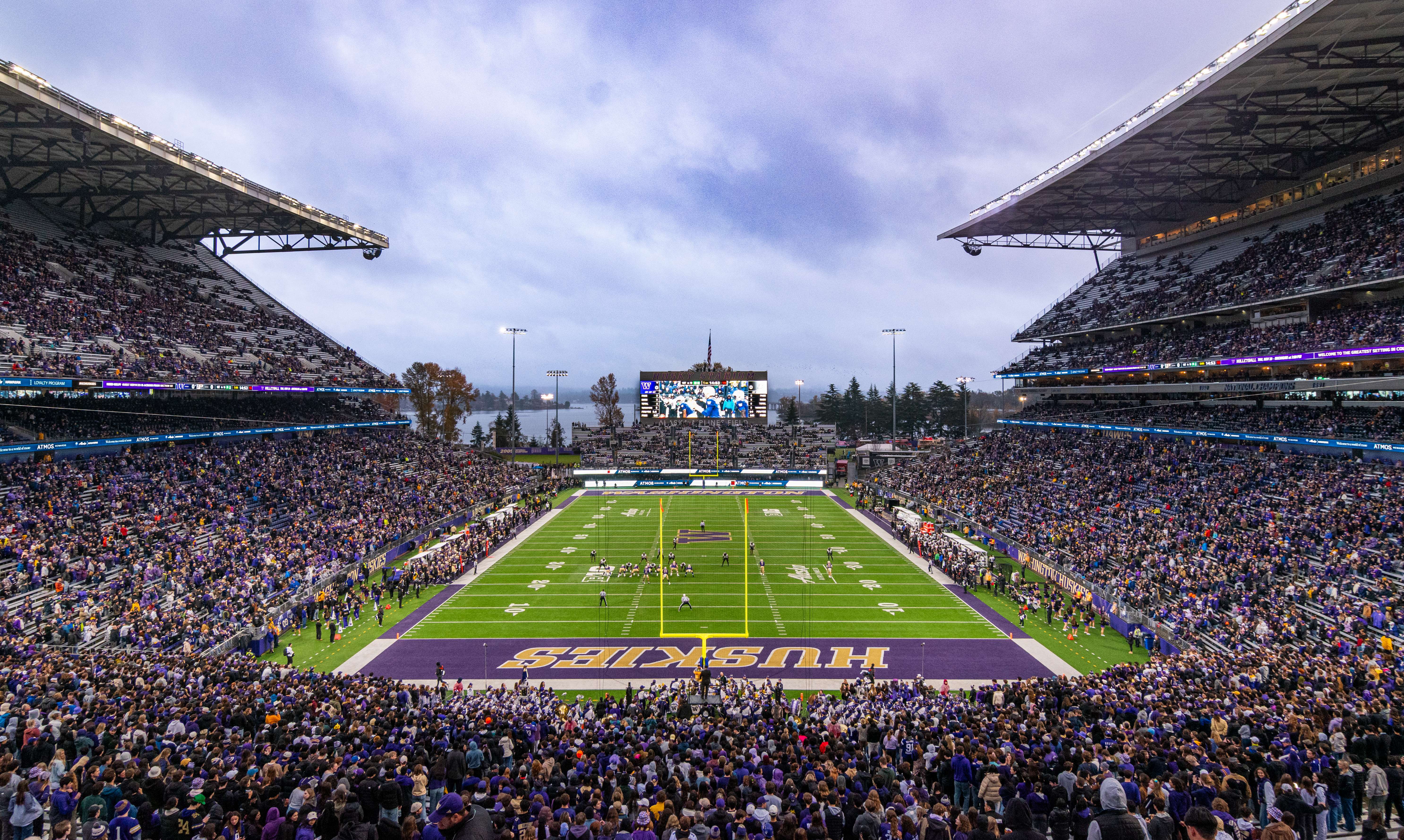
The 7th oldest venue in college football, Husky Stadium opened in 1920 and has been a sports staple in Seattle ever since, drawing crowds in for more than a century. Not only does the stadium find itself amongst historic company but, with a capacity of over 70,000, it also stands as one of the largest in the sport. The Huskies’ home, in fact, is the most sizeable venue in the Pacific Northwest – bigger than even the Seahawks’ Lumen Field a few miles south – and is renowned for both its stunning environs and the tough atmosphere that the University of Washington has cultivated here over the years.
Hugging the shoreline of Lake Washington, Husky Stadium is often heralded as “The Greatest Setting in College Football.” Views of boats, seaplanes and the world’s longest floating bridge dominate the sightlines beyond the venue’s east end, while the cityscape of the U-District sits nestled behind tall evergreens on the west side.

The proximity of the lake has brought about “sailgating”, arguably one of the coolest pre-game traditions in sports, where fans can commute and party on yachts, pontoons and trawlers before heading to the game. Though some vessels are private, many are docked and open to roam; others still offer premium experiences, such as Argosy and their roundtrip cruise across the water from Kirkland. The facility stands out as one of only two college football venues – the other being Tennessee’s Neyland Stadium – where it’s possible to take a boat directly to the gates.
Once inside, folks will find that Husky Stadium is far and away the loudest in college sports, having recorded many instances of crowd noise over 130 decibels. The building’s upper decks often rattle and bounce when fans get loud for touchdowns and the like, with the crazed throngs even causing small earthquakes on several occasions.
The Husky fandom is also known as one of the progenitors of The Wave, helping to popularize the phenomenon in the 1980s. Despite the first veritable cases happening at Colorado Rockies (NHL) and Oakland Athletics (MLB) games, UW die-hards are typically credited with perfecting The Wave technique – although they themselves began the tradition by going from bottom to top instead of around – and guiding it into the national spotlight, where it would catch on at sporting events around the world.

In addition to the consistently innovative and deafening crowds that pack Husky Stadium, the gameday presentation itself is quite the show. A boat siren sounds across the campus prior to each game, and purple smoke fills the field as the Huskies come storming out. They’re led dutifully by Dubs, an Alaskan Malamute that serves as the school’s live mascot. Throughout the year, the team runs popular themed events as well, such as the annual “Purple Reign” game where everyone is encouraged to turn out in Husky purple.
Architecturally, the Huskies do things in a similarly knockout fashion. Most notable are the huge overhangs that shield fans from the persistent PNW rain, providing comfort without compromising on ambiance. The vomitoriums to the seats are also wood-clad and feature a backlit Washington logo, each one built as if it were the players’ entrance tunnel. Low-key lighting hangs above the bowl, serving to not blind those seated closer to the field.
Visitors are treated to a plethora of food trucks and activity tents on the adjacent practice field, which is part of the stadium on game days. Called The Zone, this space features a rotating line-up of local spots, from Dick’s Drive-In to Ivar’s Fish Bar, and Kidd Valley Burgers to Delfino’s Chicago Style Pizza.

The Huskies, of course, have a past that runs even deeper than their home turf. UW began as an independent in 1889 and was a founding member of the Pacific Coast Conference in 1916, the predecessor of the Pac-12 Conference where they spent more than a hundred seasons before joining the Big Ten in 2024.
The team has claimed the 1960 and 1991 championship titles, going undefeated during the latter campaign. In the College Football Playoff era, Washington appeared in the postseason in 2016 and advanced through to the title game in 2023. In the southeast corner of Husky Stadium, the Coaches Walk of Honor immortalizes the greats who have been at the helm during these periods of success, including the likes of Don James, Jim Owens, James Phelan and Gil Dobie. Photos and plaques celebrating some of the most memorable program moments line the walls of the main concourse too.
Between their grand resumé, great environment and gridiron dominance, the Huskies have built an impressive legacy. They’ve developed strong rivalries – leading both the Cascade Clash with Oregon and the Apple Cup with Washington State – fostered a fun atmosphere and brought a true college football spirit to the rainy shores of Seattle.
Info Invasion
Parking: Take light rail to the Univ. of Washington station
Nearby Venue(s): Husky Ballpark, Lumen Field
In the Area: Burke Museum of Natural History and Culture
Leave a Reply