


Toronto, Ontario
🏒 Toronto Marlies
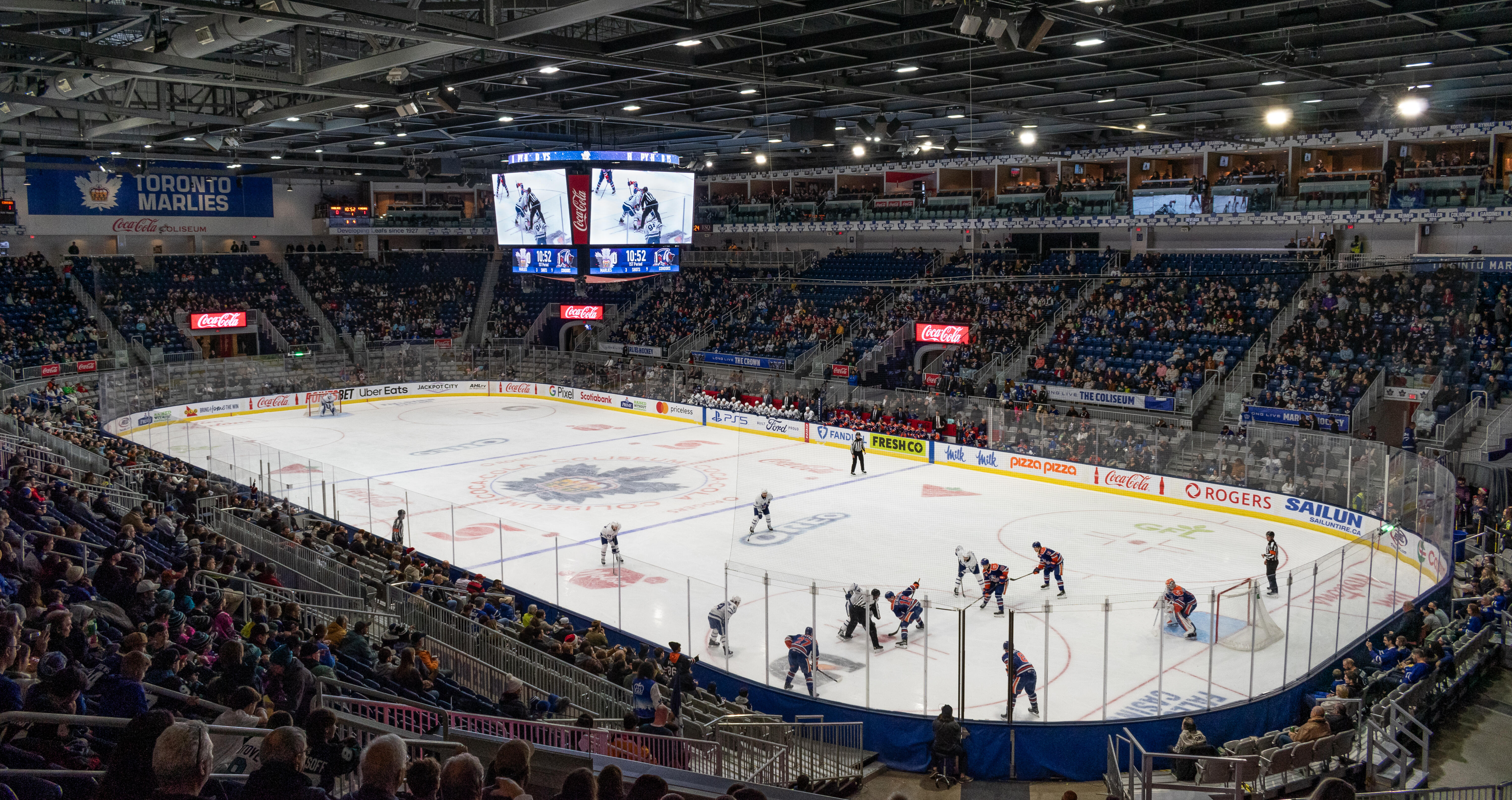
Although a relatively new facility in the hockey world, Toronto’s Coca-Cola Coliseum originally opened in 1921 as a livestock venue, hosting everything from farm shows to agricultural fairs. Retrofitted for sports – namely, ice hockey – in 2003, the Coliseum now holds the distinction of the oldest building used by a professional hockey team.
Around the turn of the century, the NHL’s Maple Leafs were looking to place their top-level minor league team at the Coliseum. The barn’s first tenant was the AHL’s Roadrunners, whom the Leafs had moved from nearby Hamilton, but the team only lasted one season. In 2005, a new franchise arrived from St. John’s and took on the Marlies moniker. The team, also a member of the AHL, adopted imagery closely aligned with the branding of its parent club and have been entertaining crowds along the lakeshore ever since.

Just 3.5km apart, the Leafs and Marlies enjoy one of the closest affiliation agreements in all of pro sports. The Marlies, it follows, sometimes receive remarkable hand-me-downs from the more contemporary confines at Scotiabank Arena. In the summer of 2015, for example, the Leafs’ old scoreboard – deemed too small and not flashy enough – was installed at the Coliseum for the Marlies’ use – one arena’s trash is another arena’s treasure, after all.
Despite the AHL team being a modern addition to the Toronto sports landscape, the Marlies legacy stretches back more than a century and finds their origins in a junior hockey team that was owned by the Leafs from 1927 to 1989. Initially called the Marlboros, in honor of the Duke of Marlborough, the nickname was shortened to just “Marlies” to avoid negative connotations associated with the cigarette brand of the same name. The team would move to Guelph in the ’90s, but by then, the Maple Leafs had proper minor league affiliation with the franchise that would later become the modern-day Marlies, which originated in New Brunswick in 1978. At Coca-Cola Coliseum, decorative maple leaves with the names of standout Marlboro and Marlie players line the edges of the suite level balcony, a permanent enshrinement of those who helped shape the Greater Toronto hockey scene.

Among the arena’s concession stands, meanwhile, is a small shrine to the Toronto St. Pats – one of the former names of the NHL team that would become the Maple Leafs. At “St. Patties” – a purveyor of burgers, of course – columns and walls are decorated with iconic green St. Pats logos and old team photos.
The Marlies pay homage to the area’s train history too, with players entering the ice through a tunnel designed in the style of a railroad crossing. But to even get to that, the team must cross the main concourse, giving fans multiple opportunities to interact with the stars as they make their way to and from the ice. Flags are also a big deal at the Coliseum, with cheerleaders ardently waving Marlies banners all throughout the game, using the flagpoles themselves to stamp the metal bleachers and generate some noise in the arena. Additionally, prior to each game, flag ambassadors hold a giant Marlies flag and Canadian flag across the ice.
And during their time in Toronto, the Marlies have made some waves in the AHL. They’ve clinched the regular season title twice, won 7 division titles, and secured two Calder Cup victories in 2018 and 2026.
The Coca-Cola Coliseum – also home to the Toronto Sceptres of the PWHL and the future host of the Toronto Tempo, the WNBA’s first team outside the US – has done well to cement itself as one of the most unique and adaptable arenas in the Golden Horseshoe. From its days showcasing animals to the present-day where beasts take to the ice and the hardwood, loads of Toronto’s cultural history has been – and will continue to be – written within these walls.
Info Invasion
Parking: Find a garage or space in nearby Liberty Village and walk through the GO Station to the arena; or just take the GO Train
Nearby Venue(s): Scotiabank Arena, BMO Field
In the Area: Peruse the massive collection at the Royal Ontario Museum
Leave a Reply